
Research
Human attention is a signal that is hard to fake and almost never used. An expert’s eyes move differently when they are tired, when they are looking at something unfamiliar, and shortly before they make a mistake. Those same movements carry spatial information that would otherwise take hours of manual annotation to produce. My work runs along three lines: analysing that signal, using it, and generating it.
Analysing expert gaze
The question. Diagnostic quality is normally assessed after the fact, from the report. By then the error has been made. Eye movements are recorded continuously and in real time — can they say something about the state of the clinician while they work?
We have shown that a radiologist’s gaze changes measurably with accumulated workload, that it changes according to the type of abnormality on the image, and — the strongest claim — that an impending diagnostic error can be predicted from the gaze that precedes it. Gaze is therefore a candidate instrument for two things radiology currently lacks: an objective measure of reader fatigue, and an early warning of error before it reaches the report.
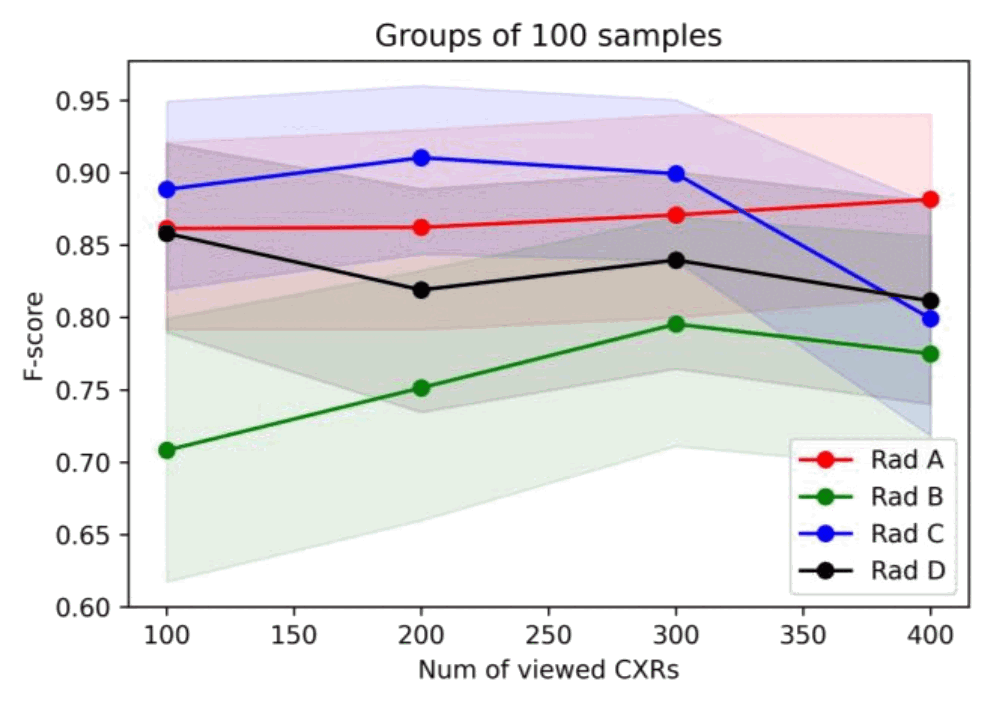
- Artificial Intelligence for the Analysis of Workload-Related Changes in Radiologists’ Gaze Patterns — IEEE JBHI, 2022
- Changes in Radiologists’ Gaze Patterns Against Lung X-rays with Different Abnormalities — Journal of Digital Imaging, 2023
- AI-based analysis of radiologist’s eye movements for fatigue estimation — SPIE Medical Imaging, 2022
Gaze as a control signal for interactive segmentation
The question. Annotating medical images is slow and expensive, and it matters not only for building datasets but for radiotherapy planning. A radiologist reading an image is already producing localisation data — they look at what matters. Can expert eye movements be used to drive interactive segmentation?
Gaze is used for correction: the clinician looks over the wrongly segmented regions and the prediction updates — which is faster than redrawing a contour by hand.
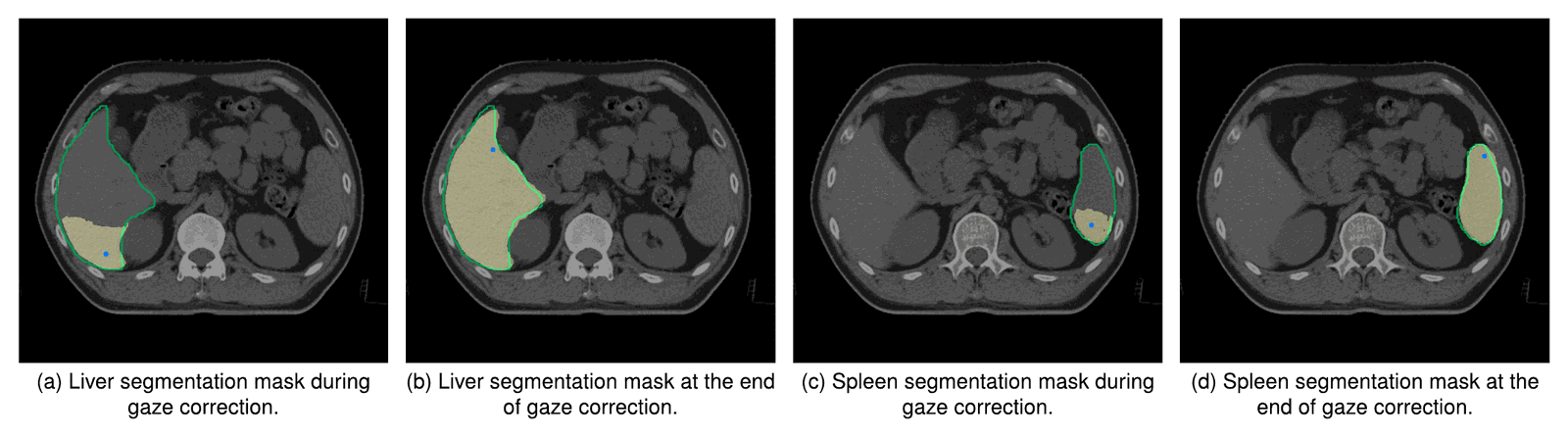
- Gaze Assistance for Efficient Segmentation Correction of Medical Images — IEEE Access, 2025 · Q1
- Zero-Shot Gaze-based Volumetric Medical Image Segmentation — CVPR 2025 workshop
- Temporal Gaze Dynamics as Zero-Shot Prompts for Volumetric Medical Segmentation — NeurIPS 2025 workshop
- From Human Attention to Diagnosis — NeurIPS 2025, main track
- Gaze-based attention to improve the classification of lung diseases — SPIE Medical Imaging, 2022
Modelling human attention
The question. One of the central obstacles in eye tracking is that gaze data is hard to collect: it takes experiments with human participants. It is made worse by the fact that every task needs its own data. One way out is to generate synthetic gaze.
We model human scanpaths during reading, transfer those models across languages, and use the synthetic trajectories as an additional signal in RLHF.
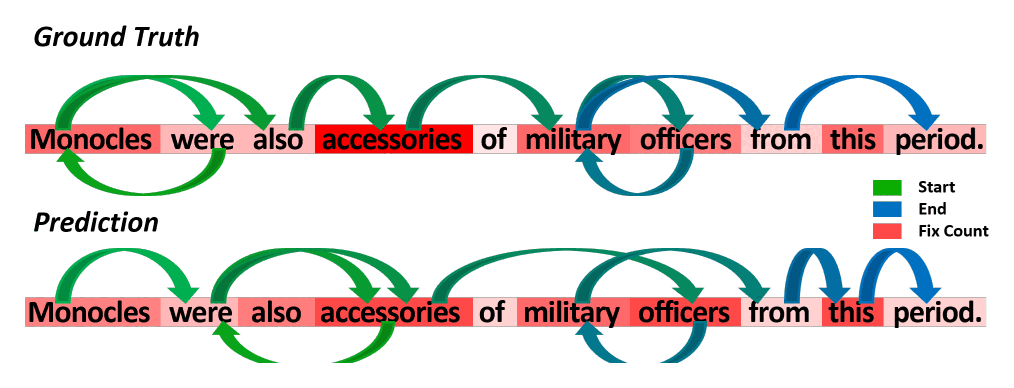
- Enhancing RLHF with Human Gaze Modeling — EMNLP 2025, main track
- How Well Can AI Models Generate Human Eye Movements During Reading? — EMNLP 2025 workshop
- Multilingual Synthetic Scanpaths — ICML 2026 workshop
- Cross-Lingual Transfer Learning for Enhanced Synthetic Scanpath Prediction — AAAI 2026 workshop
Where the lab is going
Three further lines are active now:
Non-invasive risk profiling for neurodegenerative disease
Electronic health record analysis
IVF embryo assessment